




Biophysical Characterization
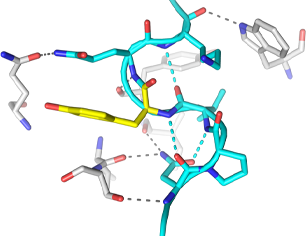
Protein characterization provides detailed insights into a protein’s structure, function, and behavior.
By analyzing different properties, researchers can better understand how proteins interact with other molecules and perform their biological roles. Accurate characterization is crucial for drug development, and understanding diseases at the molecular level, allowing scientists to design targeted therapies and novel biotechnological applications.
Biomolecular Interaction

Binding affinity experiments are conducted to measure the strength of the interaction between two molecules, such as a protein and its ligand. The TCSB is equipped with state-of-the-art instruments designed for analyzing molecular interactions and determining binding affinity (Kd).

NanoITC, TA Instruments
NanoITC (Isothermal Titration Calorimeter), is mostly used for studying the binding of small molecules to macromolecules (the binding of a drug to its target protein).
This instrument is highly sensitive and uses solid state thermoelectric heating and cooling systems to precisely control temperature, and has an injection syringe assembly for efficient and accurate delivery of titrant.
The NANO ITC is based on a physical technique that can determine the binding affinity (Ka), enthalpy changes (ΔH), and binding stoichiometry (n) of the interaction between two or more molecules. These measurements allow to deduce the Gibbs energy changes (ΔG) and entropy changes (ΔS), using this equation: ΔG = -RTlnKa = ΔH-TΔS.
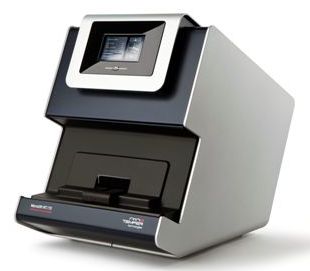
MST, NanoTemper
MST (Microscale Thermophoresis) measures the binding interactions between molecules by detecting changes in their mobility under a temperature gradient.
When a ligand binds to a target molecule, alterations in size, shape, charge, or hydration shell affect its movement. By fluorescently labeling the molecules, MST can track these mobility changes in very small quantities. This technique provides the binding constant (Kd) without requiring large amounts of pure sample, as only the labeled molecules are monitored, making it highly efficient for studying molecular interactions.
Protein Stability
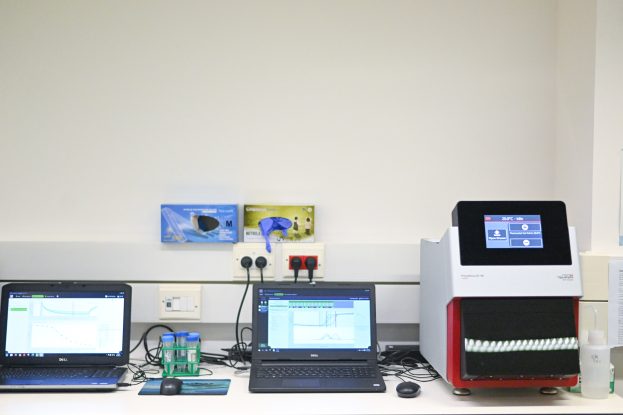
NanoDSF, NanoTemper
NanoDSF (Differential Scanning Fluorimetry) is a label-free technique used to measure protein stability by detecting changes in the fluorescence of intrinsic tryptophan and tyrosine amino acids as the protein unfolds.
It allows stability screening of antibodies, enzymes, and membrane proteins, as well as, analyzing protein-ligand interactions, formulations, and overall protein quality. Additionally, aggregation can be detected using back reflection technology. This technique requires small sample volumes and obtain reliable data on protein behavior under varying conditions.
Mass Photometry
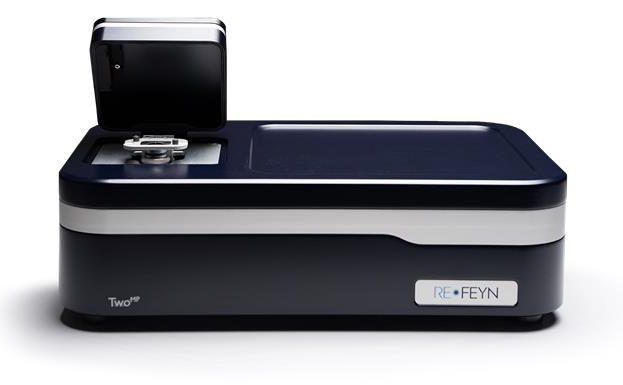
TwoMP, Refeyn
TwoMP is a mass photometer that enables rapid, label-free measurement of the molecular mass of individual biomolecules in solution. The technique can be used to determine molecular mass and oligomeric state, assess sample homogeneity and aggregation, and characterize different molecular species and molecular complexes. Mass photometry requires only small amounts of sample and provides measurements within a few minutes, making it a useful tool for rapid assessment of protein quality and molecular assemblies.